September 17, 2026 • 3 min read
September 18, 2026 • 16 Min Read

Pick the tool that makes the second variant cheap, because the first one was never the hard part. Generating a good video ad is solved. Generating thirty where the hook, the actor, the aspect ratio and the offer all change independently, and every one of them is still on brand, is the job.
The tools below split into two shapes. Some are ad production systems that take a script or a product URL and fire out finished creative for Meta and TikTok. Others are canvases where you build the pipeline and keep control of every step. The mismatch between those two shapes is usually why a tool disappoints, so it is worth knowing which one you are buying before the trial starts.
Four things, in roughly the order they become the reason a tool gets dropped.
A test is only readable if the variants differ in a way you chose. Tools that regenerate the whole ad from a fresh prompt give you thirty different ads rather than thirty versions of one, and you learn nothing about the hook because the visuals moved too. Look for a tool where you can hold the script and swap the actor, or hold the actor and swap the first five seconds.
Parallelism is the feature that decides whether a variant sweep takes an afternoon or a week, and it is the one most often gated behind a higher tier. Check the concurrency limit on the plan you would actually buy, not the one on the pricing page headline.
Every variant needs to exist at 9:16 for Reels and TikTok, 1:1 and 4:5 for feed, and often 16:9 as well. A center crop pushes your product or your subtitle off the frame, so the resize either re-composes the shot or it hands you back work.
Most of the time on a variant set goes into the near-misses: the take where the actor mispronounces the product name, the resize that buried the logo. Ask what happens when one step is wrong. On a canvas you edit that step and re-run it. In a one-shot generator you start the brief again, and across thirty variants that difference is the whole budget.
Tool | Shape | Variant mechanism | Placement resizing | Publishes to ad accounts |
Melius | Agent-run node canvas | Up to 10 variations per node in parallel, plus input swap on a saved workflow | Magic Resize, re-composes per ratio | Not yet, export and upload supported |
Arcads | AI actor ad platform | Workflows: one script across many actors and languages | Resize Video, 16:9 to 9:16 to 1:1 | No |
Creatify | URL-to-video ad platform | Batch Mode, scripts by avatars by templates | Per-network formats | Yes, on higher tiers |
Superscale | Agentic ad platform | Named agents generate and iterate from one brief | 1:1, 4:5, 9:16 and 16:9 with safe zones | Not yet, launching is marked coming soon |
Pencil | Enterprise adaptation platform | Feed Variations, a table of columns mapped to layers | AI Auto-Resize, statics only, in beta | Yes |
Melius is the Agentic OS for creative work: a node-based creative canvas that AI agents drive. Each prompt, upload and result is a node, and edges pass one node's output into the next, so a variant pipeline sits in front of you as a graph, open at every step.
For ad variants the useful property is that the graph is the unit of reuse. You build one ad once, then swap what you want to test. Select the upload node, press Cmd+R to add a new input, and every node downstream of it re-runs. Change the script node instead and the visuals hold. That is what makes a set of variants readable as a test rather than a pile of different ads.
You do not have to sit on the canvas to do it. The same pipeline runs from the command line, from the API, or from Claude over the Model Context Protocol (MCP), and the in-app agent, Mel, can build the graph from a plain-language brief. There is a Slack agent too, on the Professional plan and above. Many people who run variants on Melius never open the canvas at all.
Setup cost is real for one-time use. You are building a graph, and on the first ad that is slower than pasting a URL into a tool with one button. It pays back on the second variant and every one after.
Two gaps are worth knowing before you commit. Melius does not publish into Meta or TikTok, so the handoff from finished creative to a live ad set stays manual. And captions are still the one part of this work that leaves the canvas. That will change with the timeline editor tool, which is currently in development.
Best for: teams running readable creative tests across many variants who want generating, editing and resizing on one surface, and who are comfortable trading a publish button for control over every step. See pricing for plans and credits.
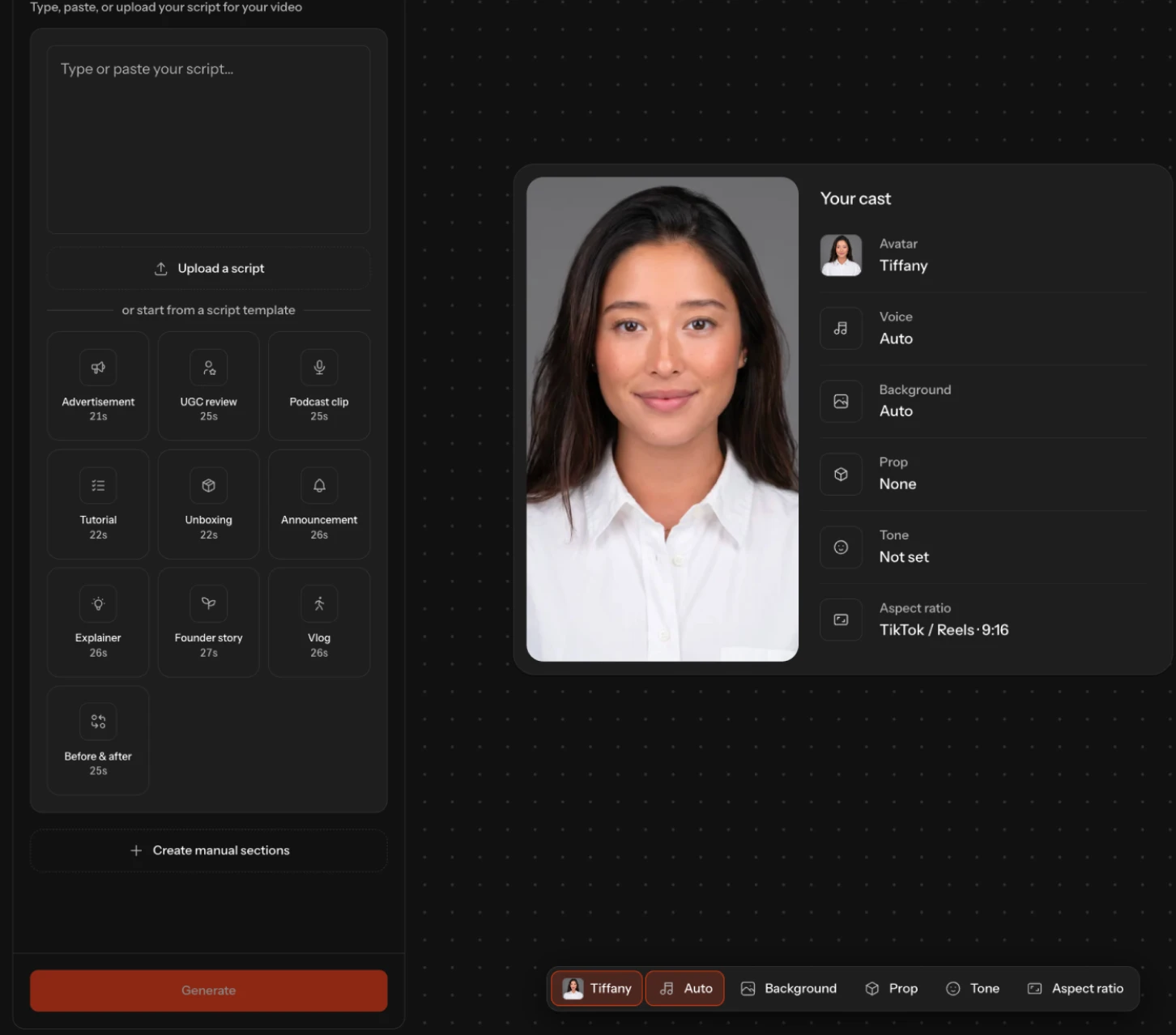
Arcads is the most single-minded variant engine on this list. You write a script, pick from its library of licensed AI actors, and it produces user-generated-content-style talking-head ads. Everything in the product is built around permuting one ad rather than making one ad well.
Its Workflows feature is the clearest example anywhere of what a variant sweep should look like: the company's own published example takes one script and one product image and returns 20 finished 8-second clips across 10 actors in English and Spanish, in a single run. Hook Repurposer takes an ad that already works, reads its first 12 seconds, and rebuilds that opening for your product, which is the fastest way to test angles without rewriting the body.
Arcads publishes no prices. There is no pricing page on the site, and the dollar figures only appear at the in-app paywall or through sales, which is real friction if you need a number before approval. Plan names and allowances are public, though, and so is the credit math, which is worth doing before you sign up: a talking-actor video costs 800 credits per minute per actor, rounded up to the next full minute, and the entry plan carries 8,000 credits a month. A two-minute ad with two actors is 3,200 credits, so roughly 40% of the month on one test. Credits do not roll over on the lower self-serve plans, and the account is blocked once they run out.
The format is also narrow by design. This makes actor-led ads, so if your creative is product-led, motion-led or anything without a person talking to camera, it is the wrong shape.
Best for: performance teams whose creative is spokesperson video and who want to test actors, hooks and languages against each other at volume.
Creatify starts from a product URL where Arcads starts from a script. Paste the link, and it pulls the images and copy off the page and builds video ads around AI avatars, which makes it the shortest path from a live product listing to something you can run.
Batch Mode is the variant feature. You choose several generated scripts, several avatars and several visual templates, and it produces the combinations in one run. Ad Cloner works from the other direction, recreating the structure of a reference ad that already performs.
Read the entry tier carefully, because this is where the batch story breaks. The lowest paid plan is limited to one generation at a time, which is the opposite of what a variant sweep needs, and running five at once starts at a higher tier. The same entry tier carries a small monthly credit allowance against a cost of 5 credits per 15 seconds of rendered video, so it is a trial rather than a testing budget. Neither number is hidden, but together they matter.
Two more things to check in a trial. Batch Mode was taken out of the dashboard and is now reachable only by direct link, and it does not appear in the current plan comparison table, so confirm you can still get to it before you buy for that reason. And the ad-launching integrations start at the higher tier, not the entry one.
Best for: direct-to-consumer teams with a live catalog who want ads generated from product pages and pushed out without a handoff, and who will pay for the tier that runs them in parallel.
Superscale is an agentic marketing platform. You give it a product or landing page URL, and a set of named agents — a script writer, a video ad editor, a motion designer and an ad copywriter — research competitor ads through the Meta Ad Library and produce the creative from what they find.
The variant story here is about compliance as much as volume. One brief produces parallel outputs at 1:1, 4:5, 9:16 and 16:9, with the talent and product re-centered and the safe zones respected for each placement, so copy and product stay inside the region each one actually shows. Brand kit adherence and batch generation sit together, so consistency holds across a whole run. One useful disambiguation before you go looking: the company is at superscale.ai, and it has nothing to do with the mobile-games business at the similarly named .com.
Check what has actually shipped before you buy on the pitch. Launching and scheduling campaigns straight into Meta or Google is marked coming soon on Superscale's own site, and it does not publish to TikTok at all, so today the output is publish-ready assets you take to the ad account yourself. Some of the company's marketing copy elsewhere reads as though launching is live, which is worth resolving in a demo.
This is also the most expensive entry point on the list. The company's own pricing FAQ says you get free credits at signup, then a 5-day trial, then paid plans from a premium monthly tier.
One thing to watch when you research it: Superscale publishes a large set of comparison and alternatives pages about its rivals, and some carry stale competitor pricing. One rival's own site now lists a materially higher starter price than the figure on Superscale's comparison page. They are marketing assets, so check any number you find there against the source.
Best for: paid social teams who want research, generation and placement coverage handled in one loop, and who can live with taking the finished assets to the ad account themselves.
Pencil is built for enterprise marketing teams, and it is honest about that. Owned by The Brandtech Group since 2023, it describes itself as an operating system for marketing, pulling models from several providers into one editor with brand governance wrapped around them.
Its variant mechanism is the most literal on this list. Feed Variations is a spreadsheet-style table where columns — product, market, audience, language, header, image and call to action — map onto layers of the creative, and any cell can be filled by AI: hover it, choose Ask AI, then drag the corner to populate the rest the way you would fill a formula down a column. If your variant problem is genuinely combinatorial, a table of rows is a more honest interface than a chat box.
The low-cost entry plan is not the product you are reading about here. It carries a limited generation allowance, and bulk AI generation across feeds, audiences and markets is gated to the custom-priced Pro tier, which means a quote and a procurement cycle.
The resizing story is weaker than the pitch suggests, and it matters most for video. Pencil's one-to-many rescale is AI Auto-Resize, still in beta, and it runs on static creatives only: not on templates, and not on video. Its own documentation says the output may need manual repositioning, and each output format costs a generation against your monthly allowance. So on a video variant set, the placement work comes back to you.
Pencil is stronger on static and adapted creative generally. It orchestrates third-party video models rather than running a bespoke ad-video engine, so if motion is the whole job, the tools above are shaped better for it.
Best for: brand and agency teams adapting one master creative across many markets and placements, where governance and approval matter as much as throughput.
The per-video price is the least interesting number in this comparison. Work a real test through instead.
Say you want four hooks against three actors, which is twelve ads, each at 9:16 and 4:5, so twenty-four assets. Generating them is minutes of machine time. What eats the week is the corrections: the take where the product name comes out wrong, the resize that pushed the price off the frame, the actor who reads the offer flat.
So the question to ask in a trial is not how good the first video looks. It is what happens to the other twenty-three when one input changes. If fixing the script means regenerating every asset from scratch, the cheap tool is the expensive one. If it means editing one node and re-running the branch below it, the arithmetic goes the other way, which is why a per-second rate tells you almost nothing about what a month of testing will cost.
Build the ad once as a graph, then decide what you are testing. Put the script in its own node, the product footage or image in an upload node, and the model choice on the generation node, so each is a separate thing you can change.
Run the sweep by setting variations on whichever node holds the variable: up to 10 run in parallel, which is usually enough for a hook test in one pass. Keep the outputs at low resolution while you are choosing, then regenerate only the winners at full quality, because rendering a batch you will discard is where the credits go.
Once a cut is right, Magic Resize produces each placement ratio by re-composing the frame rather than trimming it, and you can apply it to the whole batch in one instruction. Model choice is a node setting, so a library of leading models is available per step. The same approach applied to stills is covered in best AI tools for producing product photo variants.
For teams who want their variants to read as a controlled test, Melius, because Mel can build the workflow and each element of the ad is a separate node you can change while holding the rest. Up to 10 variations run in parallel, and Magic Resize re-composes the finished batch for each placement.
Change one variable at a time and run enough versions of it to be readable, which usually means four to six. Thirty ads that differ in every respect tell you which ad won but not why, so the next round starts from scratch. Four hooks on one script, or one script across three actors, gives you something you can act on.
Yes, and the method matters more than the feature. A center crop pushes your product, price or subtitle out of frame at 9:16, so look for a resize that re-composes the shot for each ratio. On Melius that is Magic Resize, which re-lays out the elements per aspect ratio and can be applied across a finished batch at once.
Less than the correction loop, which is the number most pricing pages do not show. Entry tiers commonly limit you to one generation at a time or a few minutes of rendered video a month, so concurrency usually bites before price does. Generate test variants at low resolution and regenerate only the winners at full quality, and the monthly cost falls sharply.
On Melius, you own the content you create and can use, publish and distribute it commercially, subject to the underlying model providers' terms. Melius does not use your work to train AI models. Terms differ by vendor, so check them before you run anything paid, and check them twice where AI actors or licensed voices are involved.
Rebuild one ad that already works as a graph, then swap the hook four ways and see what holds. Open Melius.
September 17, 2026 • 3 min read

September 16, 2026 • 6 Min Read

September 16, 2026 • 6 Min Read